
4 Gabion Machine Models

Horizontal Gabion Machine
Our most affordable gabion machine. Runs wire from 1.0 to 3.2 mm across a 4,300 mm weaving width. Maintenance requires no specialized training — your existing workshop team can handle it. Most buyers are producing saleable mesh within 2 days of delivery.

CNC Horizontal Gabion Machine
CNC automation on the horizontal platform. Runs wire from 1.0 to 3.5 mm, servo-driven — switch twist types with one touch, no retooling, no downtime. 30% smaller footprint than heavy duty models. 18% faster than the mechanical equivalent.

Heavy Duty Gabion Machine
Vertical-weave architecture purpose-built for thick-gauge wire. Wire range: 1.5–3.5 mm across a 4,300 mm weaving width — for gabions that hold back rivers and reinforce highways. Built for contracts where structural integrity is non-negotiable.

CNC Heavy Duty Gabion Machine
The most advanced gabion machine in the lineup. Widest wire range: 1.5–4.0 mm across a 5,300 mm weaving width. PLC automation cuts operators from 3–5 down to 2–3 — output goes up, labor cost goes down.
How to Choose the Right Gabion Machine
The right machine is determined by three variables: your wire diameter range, projected daily output, and whether your contracts are short-cycle or continuous. Use the comparisons below to narrow your choice before speaking with our engineers.
Step 1: Compare all 4 gabion machines: specs and capital investment
| Type | Horizontal Gabion Machine | CNC Horizontal Gabion Machine | Heavy Duty Gabion Machine | CNC Heavy Duty Gabion Machine |
|---|---|---|---|---|
| Drive System | Mechanical | CNC Automated | Mechanical | CNC Automated |
| Weave Orientation | Horizontal | Horizontal | Vertical | Vertical |
| Wire Diameter | 1.0-3.2 mm | 1.0-3.5 mm | 1.5-3.5 mm | 1.5-4.0 mm |
| Weaving Width | Max. 4,300 mm | Max. 4,300 mm | Max. 4,300 mm | Max. 5,300 mm |
| Twisted Number | 3 or 5 (non-ajustable) | 3 or 5 (adjustable by touch screen) | 3 or 5 (non-ajustable) | 3 or 5 (adjustable by touch screen) |
| Production speed | 38 mesh/min (adjust speed by changing pulley specifications) | 45 mesh/min (adjust speed via touchscreen) | 30 mesh/min (adjust speed by changing pulley specifications) | 40 mesh/min (adjust speed via touchscreen) |
| Motor | 7.5kW | 11kW + 7.5kW + 7.5kW | 22kW | 22kW + 15kW + 11kW |
| Workers required | 2 | 2 | 3 – 4 | 2 |
| Equipment acquisition cost | Lowest price point | Mid price point | Upper mid price point | Highest price point |
| Best For | Ideal for startups and budget-conscious buyers entering the gabion market | Best for mid-scale producers seeking flexibility, faster changeovers, and space-saving automation | Suited for contractors supplying structural gabions for civil engineering and infrastructure projects | Designed for high-volume manufacturers looking to maximize output and minimize labor costs |
Step 2: Horizontal vs. heavy duty: which architecture fits your contracts?
The difference between horizontal and heavy-duty machines isn’t about which is better — it’s about which one pays for itself before your project ends.
Short-term project? Moderate annual output? Go horizontal — lower upfront cost, faster ROI, typically paying back within 2 months.
Running at full capacity year-round? Go heavy-duty — the per-unit cost advantage compounds with every shift, making it ideal for 3-5 year long-term projects or government infrastructure contracts.
Don’t overpay for capacity you won’t use, and don’t leave a capacity gap on a long-term contract. Choose the right configuration, and every dollar works as hard as your machine does.
Step 3: Mechanical vs. CNC: speed, noise, and maintenance trade-offs
CNC models run faster and quieter, but at a cost — a larger motor means higher upfront investment (roughly 15% more) and higher power consumption. They also demand more from operators in terms of programming and setup, and routine maintenance tends to cost more as well.
Mechanical machines are simpler to operate and cheaper to maintain, but less flexible — best suited for steady, long-term production of a single mesh size.
Bottom line: if your output stays on one mesh size, go mechanical. If you need to switch mesh twist or adjust speed on the fly, CNC saves changeover time and pays off long-term.
Not sure which configuration fits your contract requirements?
Send us your wire diameter, mesh size, and output target — we’ll return a specific recommendation with configuration rationale within one business day, at no cost and with no obligation to proceed. For more buying guides, visit our article section.
Gabion Machine Specifications — Every Parameter Built to Order
YOUTE manufactures gabion machines from raw billet to finished unit at our Hebei facility — a dedicated 8,000 m² production workshop with in-house CNC machining, automatic cutting lines, and a monthly capacity of 50 units. As the original manufacturer, we own the full design and production process.
Gabion Machine Wire Diameter Specifications: Mesh Wire and Edge Wire
Wire diameter is one of the most direct variables affecting machine cost and structural output quality. Three diameter values must be confirmed before your machine is configured.
Mesh wire forms the body of each hexagonal cell. Standard range: 1.0 mm – 3.5 mm.
Thinner diameters reduce machine cost and are suitable for landscaping, light slope protection, and short-term erosion control applications. Heavier gauges increase tensile strength and are specified for permanent infrastructure, flood control, and high-load retaining structures.
Edge wire reinforces the perimeter of each gabion panel. It runs 0.5 mm – 1.0 mm thicker than the mesh wire on the same machine. Edge wire gauge is set relative to your mesh wire selection — it is not an independently configured variable.
How wire diameter affects your capital cost: Machines configured for thicker wire diameters require higher-torque drive systems and heavier mechanical components. Here’s a practical way to reduce your machine cost: specify the thinnest wire your engineering standard permits. Lighter-gauge machines cost less — and produce the same daily output.
Tell us your required wire diameter range and target application — our engineers will identify the most cost-effective configuration for your production line.

Gabion Machine Mesh Sizes: Standard Options and Custom Apertures
The mesh opening size determines the aperture of each hexagonal cell your machine produces. Selecting the correct specification at the point of order is essential — mesh size is fixed at manufacture and cannot be changed during production.
Standard mesh opening sizes available:
| Mesh Size | Primary Application |
|---|---|
| 60 × 80 | Small-scale slope stabilization, landscaping, fine-infill stone compatibility |
| 80 × 100 | Most widely specified — river training, channel revetment, roadbed protection |
| 100 × 120 | High-flow environments: dam reinforcement, flood barrier, large-stone infill |
| 80 × 120 | Transitional spec for mixed revetment and erosion control applications |
| 90 × 110 | Mid-range aperture for regional infrastructure standards |
| 120 × 150 | Maximum aperture for heavy-fill flood control and riprap retention |
Need a non-standard aperture? We’ve built machines for mesh openings no other factory would quote — including a 250 × 280 mm configuration for a Vietnamese contractor. If your tender calls for an unusual spec, send it to us before assuming it can’t be done.
If your project or regional procurement standard falls outside the table above, submit your target dimensions and we will confirm manufacturability before you commit.
Gabion Machine Weaving Width: 2000 mm to 5300 mm
Weaving width determines the maximum mesh panel width your machine can produce in a single pass. YOUTE gabion machines are available in four standard maximum widths:
| Maximum Weaving Width | Typical Use Case |
|---|---|
| 2300 mm | Single-panel production; compact facilities; lower annual output targets |
| 3300 mm | Dual-panel weaving; mid-scale production lines; most common configuration |
| 4300 mm | High-throughput facilities; large infrastructure supply contracts |
| Custom widths | Non-standard panel dimensions; confirm requirements before order |
Multi-panel simultaneous weaving — what it means for your output: All models support weaving two or more mesh panels in parallel within a single machine pass. On a 3300 mm machine configured for 1500 mm panels, for example, two panels are produced simultaneously — effectively doubling output per shift without adding floor space, headcount, or a second machine.
Matching width to your production requirement: A wider machine increases daily output and lowers per-unit production cost, but carries a higher capital cost and requires more floor space. Before specifying width, confirm the maximum gabion dimension your contracts require. Investing in capacity beyond your actual panel width adds cost without adding usable output.

Gabion Machine Power Supply and Control System Options
Supported voltage and frequency configurations:
| Specification | Options |
|---|---|
| Voltage | 220V / 380V / 400V / 415V / 480V |
| Frequency | 50 Hz / 60 Hz |
| Phase | 3-Phase |
Confirm your local electrical standard when submitting your inquiry. The machine will be configured to your grid specification before manufacture — no field rewiring required on arrival.
Control system component specification: Motors, drives, PLCs, and sensors can be specified by brand to match your facility’s existing maintenance capabilities and spare parts supply chain.
Commonly specified brands include:
If your engineering or procurement team has an existing preferred supplier, specify it at the time of order. If not, our engineers will recommend the most serviceable option for your region.
Custom Branding for OEM Buyers and White-Label Gabion Machine Orders
YOUTE supplies gabion machines to OEM buyers who resell under their own brand, and to manufacturers who require equipment that reflects their corporate identity on the factory floor.
Available customization options:
| Option | Detail |
|---|---|
| Machine color | Any RAL color code accepted |
| Logo application | Machine body, control panel housing, and electrical casing |
| Packaging | Branded export packaging and shipping documentation |
| Product labeling | Nameplate and compliance labels in your brand name |
All customization specifications are confirmed in writing before production begins. The finished machine ships with your branding applied — no post-delivery modification required.
OEM buyers with volume requirements or reseller arrangements are welcome to discuss private-label pricing and lead-time commitments separately.

Let’s build the right machine for your needs — contact us today to streamline your production and save costs.
Custom Gabion Machines for Non-Standard Mesh
Standard machines cover most specifications. When they don’t, we engineer a solution — same lead time, same warranty, same factory.
The Order Others Turned Down. We Made It Happen.
Machine
Custom Mesh Size
Response Time
The challenge
A gabion mesh producer in Ho Chi Minh City had secured a high-margin infrastructure contract requiring 250×280 mm aperture mesh — outside the range of every standard machine from Chinese and regional manufacturers. Multiple suppliers declined after receiving the specification. With an 8-month production window, a heavy-duty machine would have created a capital recovery timeline longer than the contract itself.
The YOUTE solution
Our engineers responded within one business day: a horizontal gabion machine custom-configured for the exact aperture. Low capital cost, simple structure, lead time matched to the contract window.
The result
The contract was fulfilled in full and on time. The non-standard specification — once a sourcing obstacle — became a capability no local competitor could match. The client has sourced every subsequent gabion machine through YOUTE.
“YOUTE was the only manufacturer that came back with a real solution. We completed a high-profit order no one else could fulfill — and we have worked with YOUTE on every gabion machine purchase since.”
— Gabion mesh producer, Vietnam
Have a non-standard specification? Send us the aperture, wire diameter, and output requirement — we’ll tell you what’s possible within one business day.
Get a custom quote
Why Infrastructure Contractors and Gabion Manufacturers Buy from YOUTE
YOUTE Machinery — gabion machine manufacturer since 2015. Every machine designed, machined, assembled, and tested at our Hebei facility before it ships. Factory-direct to buyers in 30+ countries.
Factory-direct pricing — no trading company, no markup
Your gabion machine ships from the same 8,000 m² facility that supplies government contractors across Southeast Asia and Africa. No agent fees. No markup. For multi-machine infrastructure tenders, factory-direct pricing saves 10–15% per unit.
Deployed Across 30+ Countries
YOUTE gabion machines run in Nigeria, Pakistan, Vietnam, and beyond — producing mesh for flood barriers, highway retaining walls, and riverbank revetments. When your project deadline depends on a machine that arrives on time and runs to spec, you need a supplier with a track record, not a promise.
Full-Lifecycle After-Sales Support
Remote commissioning via WhatsApp video call at no extra cost. Spare parts dispatched from China throughout the machine’s service life. On-site engineers available for large infrastructure deployments.
24-Hour Engineering Response
Send us your wire diameter (1.0–4.0 mm range), mesh aperture, weaving width, and local voltage. By the next business day, you’ll have a machine specification — including custom aperture configurations our competitors decline.
Custom-Configured to Your Specification
Mesh aperture, wire diameter, weaving width, PLC brand, and voltage are all confirmed in writing before production. If your contract specifies a non-standard aperture — like the 250×280 mm we built for a Vietnamese contractor — we’ll quote it.
Built In-House at Our China Workshop
Weaving heads, gearbox housings, and drive shafts are CNC-machined in-house at our Dingzhou facility. No outsourced critical components. Every machine completes a full load test against your order specification before it enters the export packing crate.
Built in-house at our China workshop. Tested under full load. Shipped ready to operate.
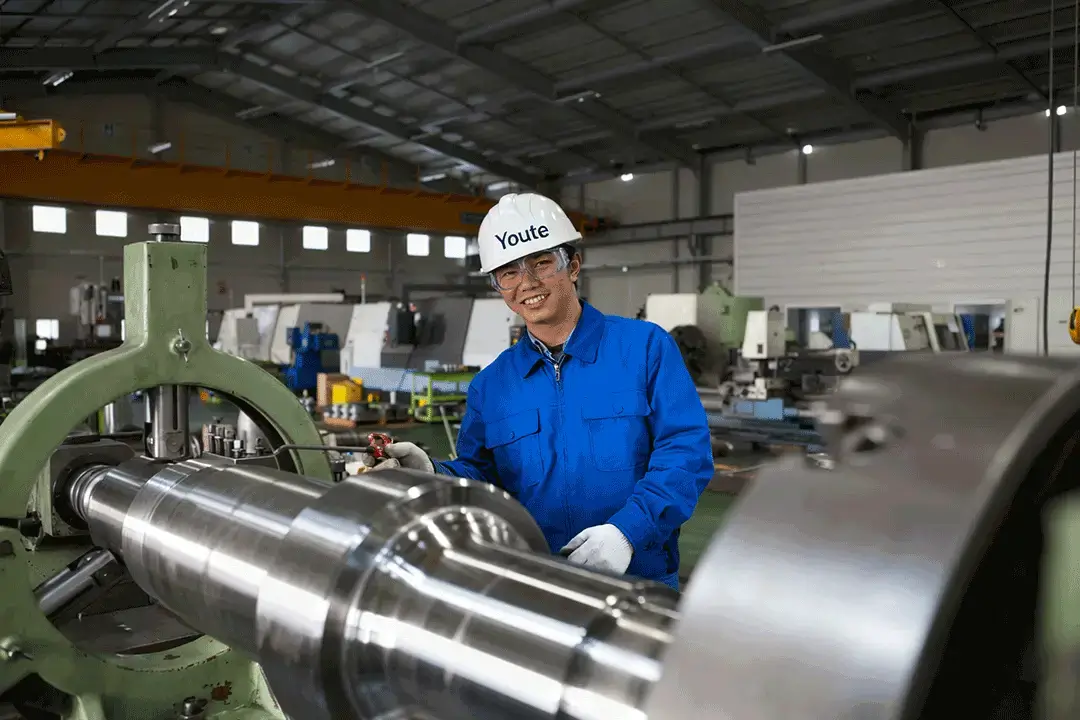
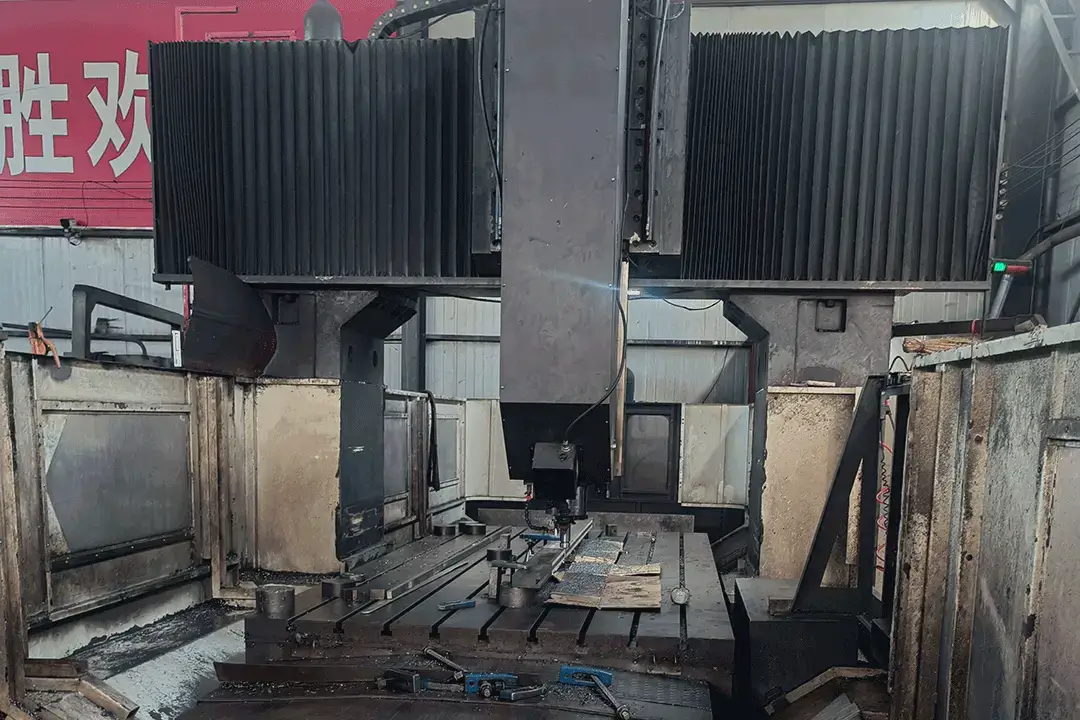
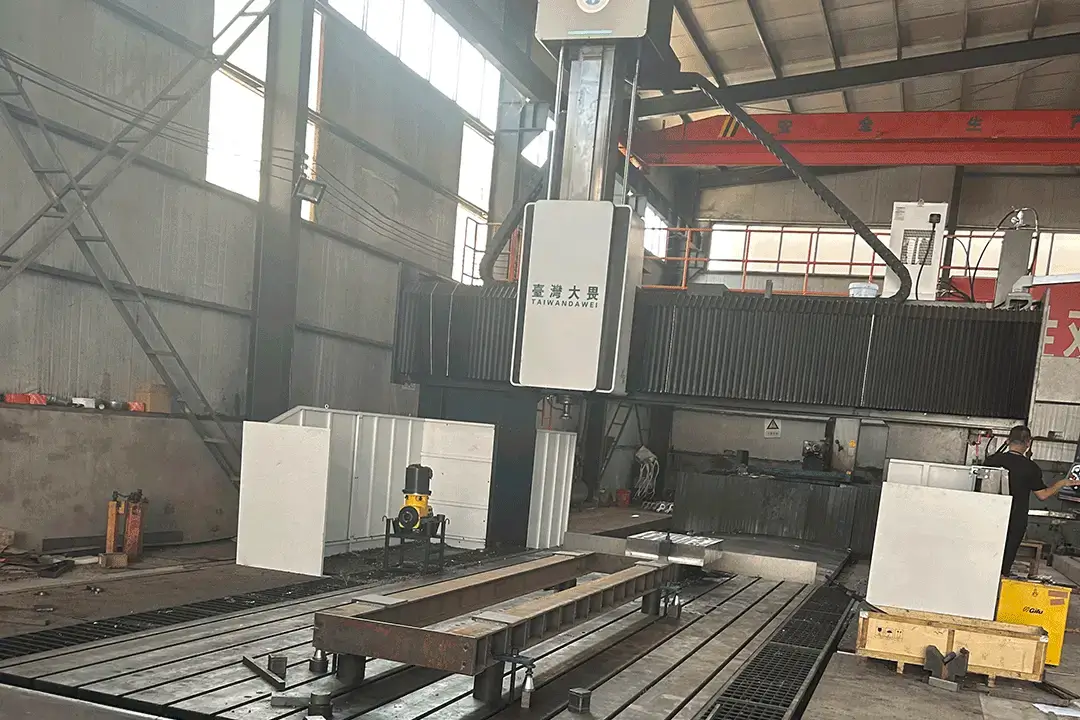
In-house CNC machining for critical drive components
Our facility operates dedicated CNC machining centers and automatic cutting lines, used exclusively for gabion machine production.
Components machined in-house include:
Outsourced fabrication introduces tolerance variation across suppliers — the compounding effect of minor deviations from each subcontractor creates unreliable geometry in the finished machine. In-house machining eliminates that variable. The team that designs the component controls how it is made.
Full load test before every shipment
No gabion machine leaves our facility without completing a full mechanical run-off under production load conditions — the same wire type and gauge specified in your order.
| Test Item | What Is Checked |
|---|---|
| Weaving speed | Output rate matches order specification |
| Wire tension consistency | Uniform tension across full weaving width |
| Twist geometry | Hexagonal cell formation within tolerance |
| Safety stop systems | Emergency stop response confirmed functional |
| Noise and vibration | Baseline recorded; abnormal readings resolved before shipment |
Test records are retained on file. Shipment clearance is issued only after all five items pass without fault. If your procurement process requires witnessed testing or third-party inspection, this can be arranged — contact us to discuss timing and access.
Complete Gabion Mesh Production Line Equipment
YOUTE supplies the full auxiliary equipment line required around your gabion machine — cutting, curling, spring tube production, wire preparation, compression, and roll packaging. Each piece is independently selectable; configure the line to your output volume, site footprint, and budget.
For buyers setting up a complete production line, we provide a combined quote covering the main gabion machine and all peripheral equipment — single order, single point of contact, coordinated lead time.
Gabion Machine — FAQ
Answers to the questions every gabion machine buyer asks.
Gabion Machine Articles

Gabion Machine Buying Guide: How to Choose the Right Model for Your Production Line
Wire diameter, mesh size, weaving width, control system — four decisions that determine which gabion machine fits your production line. A practical guide for first-time buyers and facility managers scaling up output.
Read moreGabion Wire Specifications Explained: Diameter, Coating, and Material Selection for Gabion Production
Galvanized, PVC-coated, or Galfan — the wire you run determines the machine you need. A technical breakdown of gabion wire diameters, coatings, and material standards used in slope protection, flood control, and infrastructure projects.
Read moreGabion Machine Output and Running Costs: What to Calculate Before You Buy
Daily output capacity, labor headcount, energy consumption, and payback period — the four numbers that determine whether a gabion machine investment makes sense for your operation. A practical cost breakdown for production planners and factory owners.
Read moreGet in touch
Get a Factory-Direct Quote — Usually Within 24 Hours.
Equip Your Next Infrastructure Project — Get a Gabion Machine Quote Within 24 Hours. Tell us your wire diameter range, mesh aperture, and target daily output. You’ll get a factory-direct quote with model recommendation and configuration rationale — no obligation, no broker fees, no pressure.

